Should You Listen When Your AC Tech Says It Is Time to Retire Your Unit

When Your Technician Recommendations Replacement Over Repair: What Maple Ridge, BC Homeowners Need to Know
When your technician recommends replacement over repair, it usually comes down to a few key factors — and knowing what those are can save you from making a costly mistake in either direction.
Here is a quick summary of the most common reasons a technician will recommend replacement:
- The 50% Rule applies — the repair cost is more than half the price of a comparable new unit
- The system is 15+ years old — especially true for furnaces, AC units, and heat pumps in the Lower Mainland
- Major components have failed — such as a compressor, heat exchanger, or evaporator coil
- Safety risks are present — like a cracked heat exchanger that can allow carbon monoxide into your home
- Repairs are becoming frequent — multiple service calls in a single season signal a system in decline
- Energy bills are climbing — older systems lose efficiency well before they fully break down
- Outdated refrigerant is involved — systems running on phased-out refrigerants become expensive to service
For homeowners in Maple Ridge, BC, an unexpected breakdown is stressful enough without second-guessing whether your technician is giving you the right advice. The truth is, most HVAC technicians are not trying to upsell you. A good technician weighs your system's age, repair history, performance, and safety before making any recommendation. But it helps to understand the logic behind that recommendation so you can make a confident, informed decision.
This guide brings together expert insight on exactly when replacement makes more sense than repair — and how to evaluate the advice you're getting.

Discover more about when your technician recommends replacement over repair:
- How Refrigerant Leak Repairs Add Up Over Time
- When the Cost of AC Repair Exceeds the Value of Your System
The 50% Rule: When Your Technician Recommends Replacement Over Repair
One of the most reliable tools in our diagnostic kit isn't a wrench or a multimeter—it’s a simple math equation. We call it the "50% Rule." It’s a financial threshold that helps us provide objective advice to our neighbors across the Lower Mainland.
The logic is straightforward: if a single repair estimate exceeds 50% of the cost of a brand-new, high-efficiency system, the economic viability of that repair is practically zero. Why? Because you are essentially paying half the price of a new unit just to keep an old, depreciated machine on life support.
Why the 50% Rule Matters
When we look at a system, we aren't just looking at the broken part; we are looking at the "cumulative cost" of ownership. An older unit that requires a major fix today is highly likely to require another one tomorrow. By choosing replacement, you are protecting your investment. You stop the "sinkhole" effect where you pour money into a system that will never return that value in performance or longevity.
| Scenario | Repair Frequency | Long-Term Value | Recommendation |
|---|---|---|---|
| Minor (Capacitor/Ignitor) | Low | High | Repair |
| Major (Blower Motor) | Medium | Moderate | Evaluate Age |
| Critical (Compressor/Coil) | High | Low | Replace |
Understanding What Happens After You Say Yes to a New HVAC System can help demystify the process. Once you cross that 50% threshold, the "peace of mind" factor of a new warranty and lower utility bills usually outweighs the temporary "band-aid" of a repair.
How Age Factors into When Your Technician Recommends Replacement Over Repair
In the home services industry, we often say that "age is more than just a number." For an AC unit or heat pump in the Lower Mainland, the 12 to 15-year mark is the typical retirement age. For furnaces, we might see them stretch to 20, but the efficiency drop-off after 15 years is significant.
In Chilliwack, BC, our systems work hard. Between the damp winters and the increasingly hot summers we’ve seen by April 2026, mechanical wear and tear accelerates. Technological obsolescence is a real factor here, too. A 15-year-old system is essentially a dinosaur compared to modern variable-speed technology.
If you're curious about the specifics of your heating system, our Furnace Replacement Guide breaks down how these lifespans vary based on maintenance history and local climate impacts.
Identifying Major Component Failures When Your Technician Recommends Replacement Over Repair
Not all repairs are created equal. If your technician tells you that your "capacitor is blown," that’s usually a quick, affordable fix. However, there are "terminal malfunctions" that signal the end of the road.
- Compressor Failure: The "heart" of your AC. If it dies, the cost of the part and the labor to vacuum and recharge the system often rivals the cost of a new outdoor unit.
- Evaporator Coils: If these are leaking refrigerant, especially in an older system using phased-out fluids, the repair is rarely worth the investment.
- Heat Exchanger Integrity: This is the big one for furnaces. If the heat exchanger is cracked, the unit is no longer safe to operate.
In Abbotsford, BC, our service standards prioritize your long-term comfort. If we see these major components failing on a system past its prime, we will almost always advocate for replacement to save you from a "domino effect" of future failures. You can learn more about these red flags in our guide on Warning Signs Your Furnace Needs Immediate Repair.
Safety First: Why Some Recommendations Are Non-Negotiable

While we always want to save our customers money, safety is the one area where we never compromise. When your technician recommends replacement over repair due to a safety hazard, it is because the risk to your family is real.
The most common "red alert" is a cracked heat exchanger in a gas furnace. The heat exchanger’s job is to keep combustion gases (like carbon monoxide) separate from the air being blown into your living rooms. Even a hairline crack can allow CO—the "silent killer"—to circulate through your home.
In Mission, BC, safety regulations and our own internal protocols require us to "red tag" or shut down units with confirmed heat exchanger cracks. It’s not about making a sale; it’s about preventing a tragedy. Other safety concerns include:
- Electrical Shorts: Frayed wiring or melted components that pose a fire hazard.
- Fire Hazards: Accumulation of soot or improper venting that could lead to combustion issues.
For those with specialized heating, our Boiler Replacement Guide offers more detail on how these safety standards apply to pressurized systems. Protecting your indoor air quality and your family's health is our number one priority.
Efficiency Gains and Modern Standards in April 2026
As we move through April 2026, the HVAC landscape has changed significantly. If you are still running a system from 2010, you are likely paying a "hidden tax" every month in the form of high utility bills.
Modern units now adhere to strict SEER2 ratings, which measure seasonal energy efficiency more accurately than the old SEER standards. Furthermore, the industry has shifted toward eco-friendly refrigerants like R-454B. If your old AC uses R-22 (Freon), you’ve likely noticed that a simple "top-up" now costs a small fortune because that refrigerant is no longer produced.
The Heat Pump Revolution in Langley, BC
In Langley, BC, we are seeing a massive trend toward heat pump technology. These systems provide both heating and cooling with incredible efficiency. By switching from an old furnace/AC combo to a modern heat pump, many homeowners see a 30% to 50% reduction in energy consumption.
Check out our Heat Pump Replacement Guide to see if this technology fits your home. Plus, there are often significant Rebates available through provincial and federal programs that can offset a large chunk of the replacement cost—savings that simply aren't available for repairs.
Building Trust: Questions to Ask Your Technician
We know that being told you need a new HVAC system is a big "gulp" moment. To build trust and ensure you're making the right call, we encourage you to ask your technician tough questions. A professional should be happy to provide diagnostic evidence.
Here are a few questions to get the conversation started:
- "Can you show me the physical evidence of the failure (e.g., the crack in the heat exchanger or the readings on the multimeter)?"
- "Based on my maintenance history, do you see this as an isolated incident or a pattern of decline?" (Referencing our Preventative Furnace Maintenance Guide can help you track this).
- "What is the expected 'remaining life' of the other major components if we fix this one part today?"
At Rep-Air Heating And Cooling, we pride ourselves on transparency. We work with Featured Manufacturers known for reliability, and we offer Financing options to make the transition easier. In Coquitlam, BC, our top tip for homeowners is to always look at the long-term comfort goals of the house—don't just fix the problem for today; solve it for the next 15 years.
Frequently Asked Questions About HVAC Replacement
What is the "Rule of 5,000" in HVAC diagnostics?
The "Rule of 5,000" is a quick mental math trick technicians use. You multiply the age of the unit by the cost of the repair. If the total is more than $5,000, it’s time to replace. For example, a 10-year-old unit needing a $600 repair (10 x 600 = 6,000) is a prime candidate for replacement according to this rule. It’s a great way to visualize the "sunk cost" of an aging system.
How do I know if my technician is being honest about a replacement?
Honesty usually comes with evidence. A trustworthy technician will show you the failed part, explain the safety implications, and provide a written quote that compares the repair cost against the replacement value. You can also check if they are a Family-Owned HVAC business with deep roots in the community—reputation is everything in the Lower Mainland.
Will a new system really pay for itself in energy savings?
In many cases, yes! Especially with the high energy standards of April 2026. If you are moving from an 80% AFUE furnace to a 96% high-efficiency model, you are immediately saving 16 cents on every dollar spent on heating. Over the 15 to 20-year lifespan of the unit, those savings—combined with avoided repair costs—often cover the initial price of the system.
Conclusion
At the end of the day, when your technician recommends replacement over repair, it should feel like a partnership, not a sales pitch. At Rep-Air Heating And Cooling, we treat every home like it belongs to our own family. Whether you are in Abbotsford, BC, Maple Ridge, BC, or any of our other service areas in the Lower Mainland, our goal is your absolute comfort and safety.
Don't spend another season worrying if your AC will make it through the next heatwave or if your furnace will survive a cold snap. Schedule your professional cooling assessment today and let us give you an honest, expert look at your system’s health. We’re here to help you breathe easier!
hear what our satisfied clients have to say
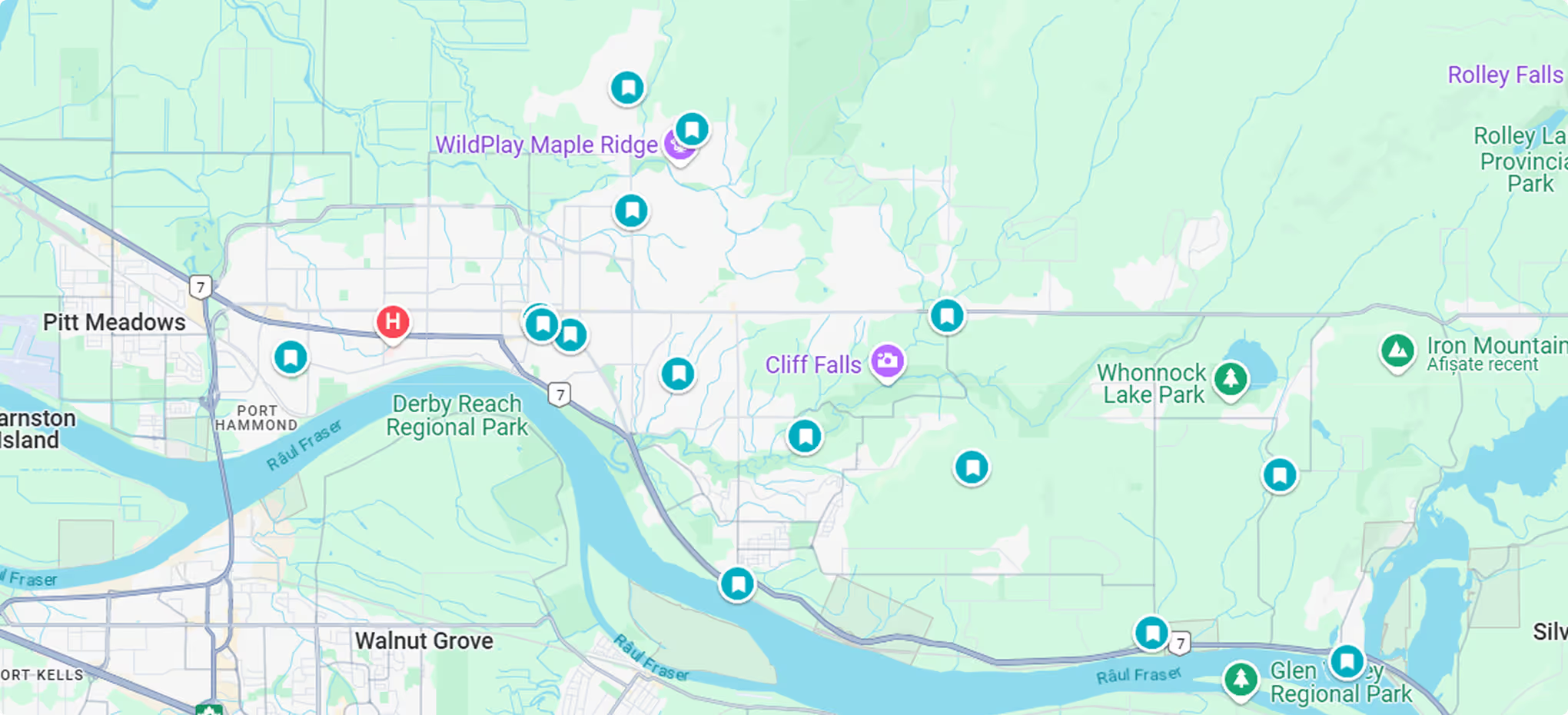
Neighbourhoods in the Fraser Valley